


Consuegra Castle (Castillo de la Muela)
12th-century fortress on the Cerro Calderico above the windmills
- Where
- Consuegra, Castile-La Mancha
- Directions
- Directions
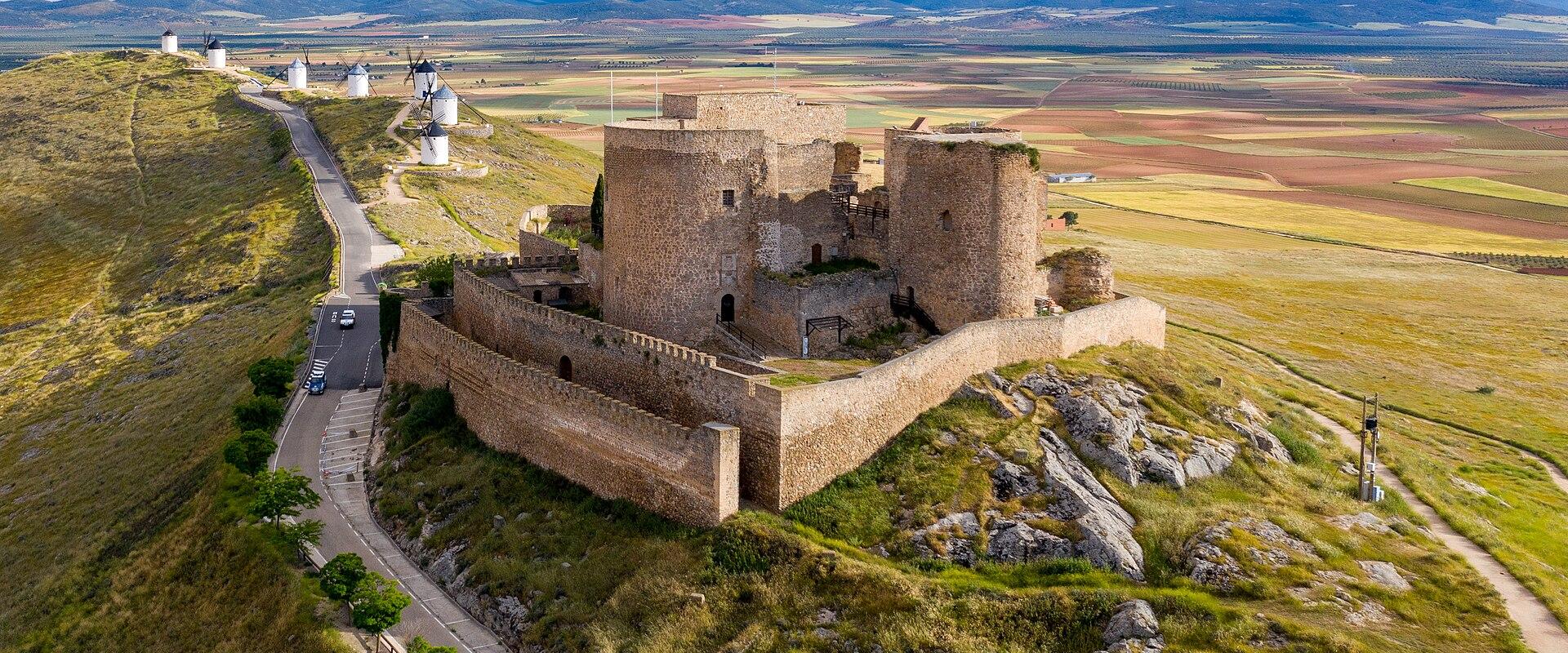
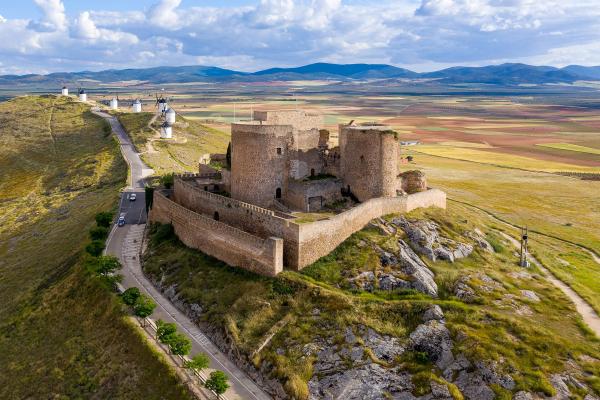
The Castillo de la Muela, the castle of Consuegra, stands on a long ridge, the Cerro Calderico, above the town of Consuegra, in the province of Toledo, and it forms the setting of one of the best-known scenes of La Mancha: a row of white windmills with conical roofs spread along the crest of the hill beside the castle. Together, castle and windmills draw thousands of visitors, who come in search of the landscape of Don Quixote, and the setting, over wide plains of cereals, vines, olives and saffron fields, makes a memorable viewpoint. The ridge is a natural strongpoint, and the site has been fortified for a very long time.
The castle has Muslim and Christian layers. A fortress existed here in the Islamic period, and after the Christian conquest in the late eleventh century, the place passed to the Knights of the Order of Saint John, the Hospitallers, who made Consuegra the seat of their priory in Castile. The castle was strengthened and enlarged in the twelfth and thirteenth centuries, and the order kept it as a headquarters for centuries. It saw fighting in the Middle Ages, and a battle fought nearby in 1097, in which Almoravid forces defeated a Castilian army, cost the life of the son of El Cid. Later, the castle was damaged during the Peninsular War in the early nineteenth century, when it was used by French troops, and many parts were ruined, and restoration work in recent decades has recovered some of the walls and towers.
The castle is a compact fortress, with a ring of walls, towers and a keep, the Torre del Homenaje, and it is built of stone and local materials. The interior of the keep and the courtyard can be visited, and from the battlements, the view across the plain is wide, with the windmills spread along the ridge to the west. The area is also associated with a hermitage built in the late fifteenth century, within the fortified enclosure, which adds a religious dimension. The surroundings are open and windswept, and the atmosphere is calm, particularly outside the busiest hours.
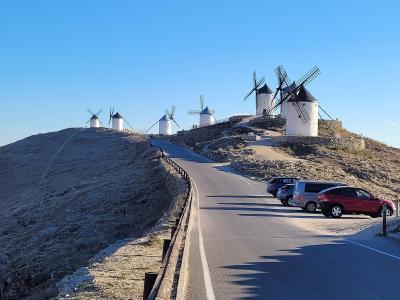
The windmills are the most famous feature. There are twelve along the ridge, dating from the sixteenth and seventeenth centuries, when they were used to grind grain, and several have names taken from the novel Don Quixote, such as Sancho, Bolero and Mambrino. Some are open to visitors and have been restored to working order, and one houses a shop or a small exhibition. Consuegra is also a center of saffron production, and each year in late October, the town celebrates the harvest with the Fiesta de la Rosa del Azafrán, when the purple crocus flowers are picked by hand.
The castle suits families, history lovers and photographers. Sunset is the best moment, as the light turns the stone gold. The climb to the top is steep, so wear sturdy shoes, and check opening times and ticket details.
Categories
More photos coming soon
Nearby Attractions
Other places to visit in Consuegra
Questions people ask
Quick Facts
Best Time to Visit
April to June and September to October offer mild weather, avoiding the intense summer heat.