


- Hours
- Open year-round, 24/7
- Where
- Consuegra, Castile-La Mancha
- Directions
- Directions
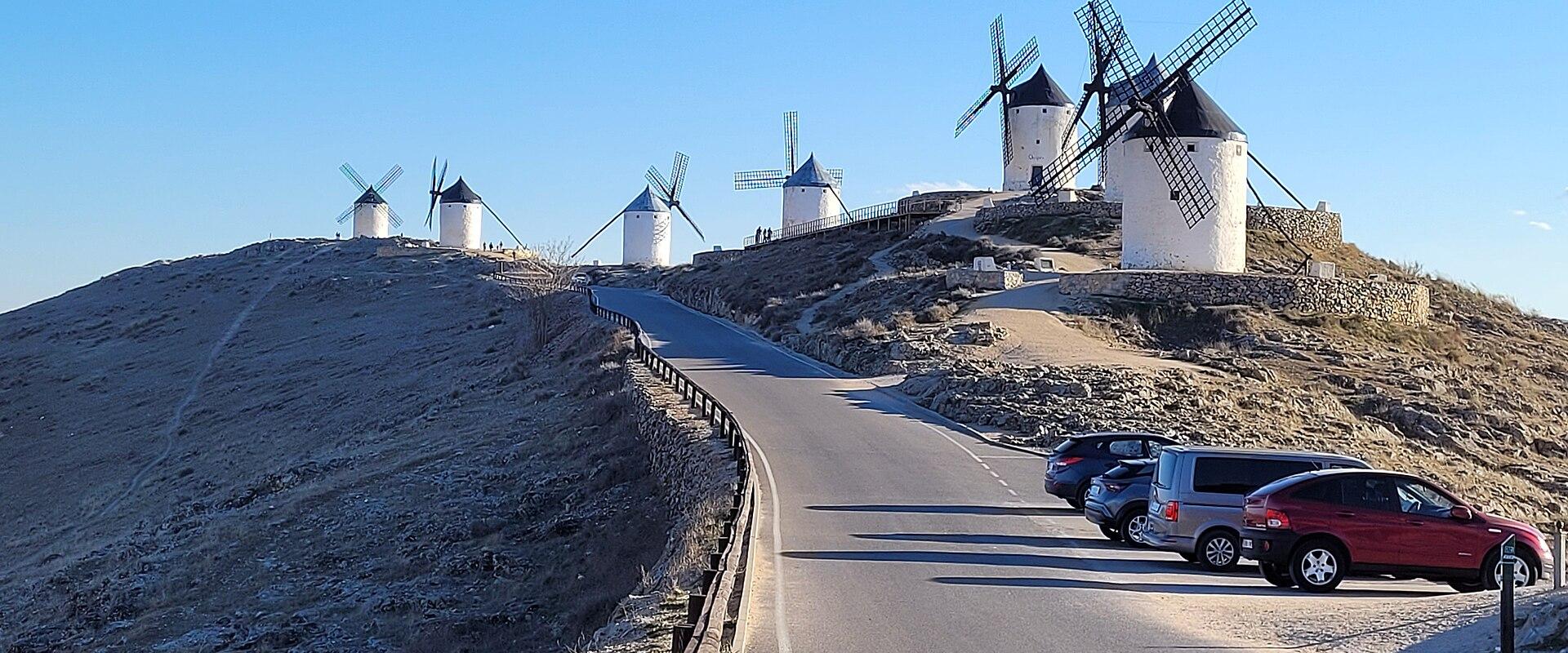
The Consuegra Windmills are among the best-known images of La Mancha, a line of white mills with pointed roofs standing along a ridge, with a medieval castle at the end, in the province of Toledo, in central Spain. They stand on the Cerro Calderico, also called the Cerro del Molino de Viento, a hill that rises above the town and the wide plain of the Mancha, and from the ridge the view stretches over fields of cereals, olive groves and vineyards to the horizon. The setting matches the picture that the Spanish writer Miguel de Cervantes drew in Don Quixote, and Cervantes’ novel has given the hill a Castilian fame, published in 1605 and 1615, in which the knight Don Quixote attacks windmills, believing them to be giants. The famous episode is set in an unspecified place in La Mancha, and several towns claim a connection to it, with Consuegra and Campo de Criptana the best known. The mills were built before and during the sixteenth century, so they stood in the landscape that Cervantes knew, though the link to this ridge is a modern tradition rather than a documented fact.
The windmills are round towers, whitewashed, with a conical roof of wood and a set of four wooden sails that turn in the wind. Inside, the structure holds a gear system that transmitted the power of the sails to the millstones, on the top floor, and the grain was ground into flour. Twelve mills remain on the ridge, out of about thirteen that once stood, and some of them are named after characters in the novel, such as Sancho, Bolero, Mambrino and Clavileño. One or two still work, and on certain days they are shown in operation, grinding grain. Some of the mills have been opened to visitors, with displays in which the middle floor is an exhibition space explaining the traditional milling methods and the importance of cereals for the local economy, and the ground floor has information and a small shop.
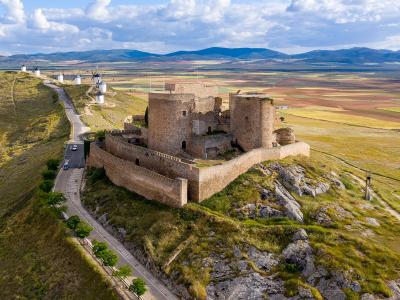
At the end of the ridge stands the Castillo de la Muela, a fortress of the twelfth century, with a history linked to the Order of Saint John, the Hospitallers, whose Grand Prior had his seat at Consuegra. The castle was damaged in the Peninsular War and restored, and visitors can walk around its walls and towers, with a view over the plain, which is the best in the area. The castle and the mills together form a memorable combination.
The ridge is open at all times, since it is a public hill, and walking among the mills is free, though some of the buildings charge a small fee and have set hours, so check locally. The plain is wide and open, and the wind is strong, which is why the mills were built here. Sunset is a popular time, when the light turns the whitewash gold. Consuegra is also known for saffron, the spice made from the crocus flower, and a festival, the Fiesta de la Rosa del Azafrán, takes place each autumn.
The town is reached by road from Toledo in about forty-five minutes and from Madrid in about ninety minutes, and there are buses and organised tours. A visit takes one to two hours.
Categories
More photos coming soon
Opening Hours
- Open
- Open year-round, 24/7
Hours and prices change, especially out of season. Check with the venue before you go.
Nearby Attractions
Other places to visit in Consuegra
Questions people ask
Quick Facts
Best Time to Visit
April to June and September to October offer mild weather, avoiding the intense summer heat.