







Plaza de España
- Where
- Seville, Andalusia
- Directions
- Directions
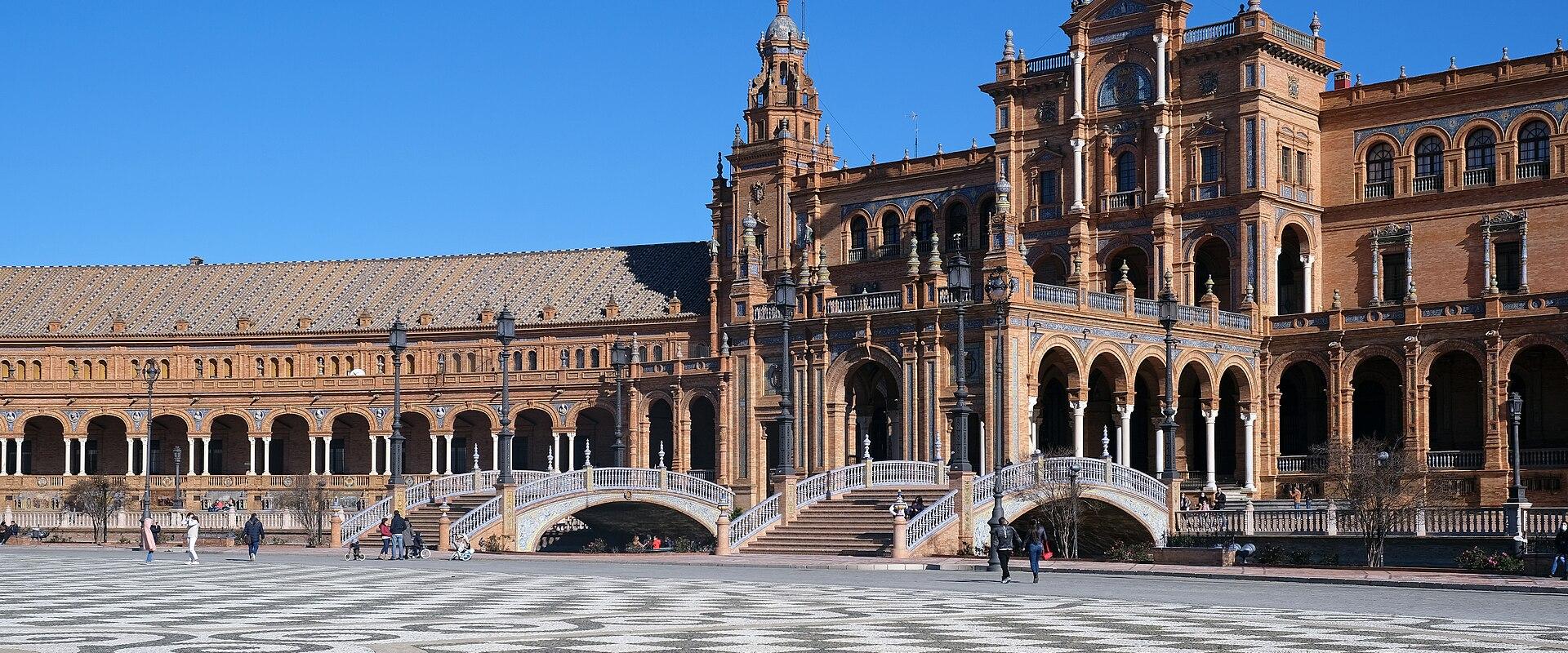
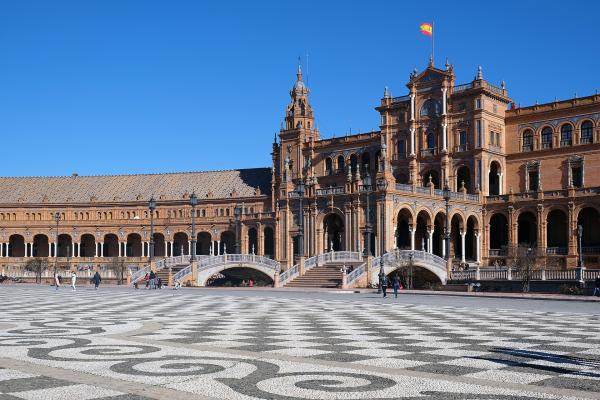
Plaza de España was the centrepiece of the Ibero-American Exposition of 1929, a world’s fair that Seville staged to celebrate links between Spain and Latin America. The architect Aníbal González designed it in a historicist style that mixes Renaissance and Baroque motifs with Moorish Revival, or neo-Mudéjar, brick and ceramics, and it was built in the late 1920s on the edge of Parque de María Luisa, known in English as María Luisa Park. The huge semicircle of buildings, about 200 metres across, opens towards the Guadalquivir river, an image intended to symbolise the embrace of Spain towards its former colonies. Today the wings house government offices, and one of them also holds the Military History Museum.
The main draw is the ceramic work. Along the base of the arcade runs a series of alcoves, one for each province of Spain, each with a tiled bench and a panel illustrating a scene from that province’s history or its map. The panels are made in the Triana tradition of painted tile, a craft the city is known for, and visitors like to find their own province and photograph it. The colours, the brick and the balustrades with ceramic balusters make a strong contrast against the sky.
A canal about half a kilometre long follows the curve of the plaza and is crossed by four bridges. These are said to represent the ancient kingdoms of Spain, Castile, Aragon, León and Navarre. Small rowing boats can be hired on the water, which is a relaxed way to see the arcade and its towers from below. A fountain stands in the centre of the open space, and horse-drawn carriages wait nearby.
The plaza has stood in for places far from Spain on film, including the planet Naboo in Star Wars: Episode II – Attack of the Clones, and it also appeared in Lawrence of Arabia. Entry to the square is free, and it is open to walk through at most hours.
Seville’s heat is strong in summer, so the best times are early morning, when it is quiet, and late afternoon, when the light warms the brick. Parque de María Luisa stretches beside it with shaded paths and ponds, and the Museo de Bellas Artes and the Real Alcázar are within reach for a full day of sightseeing. Summer midday heat is strong and there is little shade in the open square, so plan accordingly.
Categories
More photos coming soon
Nearby Attractions
Other places to visit in Seville
Questions people ask
Quick Facts
Best Time to Visit
April to June and September to October offer mild, pleasant weather ideal for sightseeing.