Getting Your Bearings
The Barri Gòtic is the oldest part of Barcelona, sitting between La Rambla and Via Laietana, with the cathedral roughly at its centre. Its core follows the footprint of the Roman colony of Barcino, founded in the 1st century BC, and much of what stands today is medieval, with a good deal of 19th- and early 20th-century neo-Gothic restoration. The main thoroughfares, such as Carrer de Ferran and Avinguda de la Catedral, are busy all day. The side streets and small squares just behind them are where the quarter is easiest to enjoy, and a loop of two to three hours covers the highlights below.
Start at the Cathedral and Its Cloister
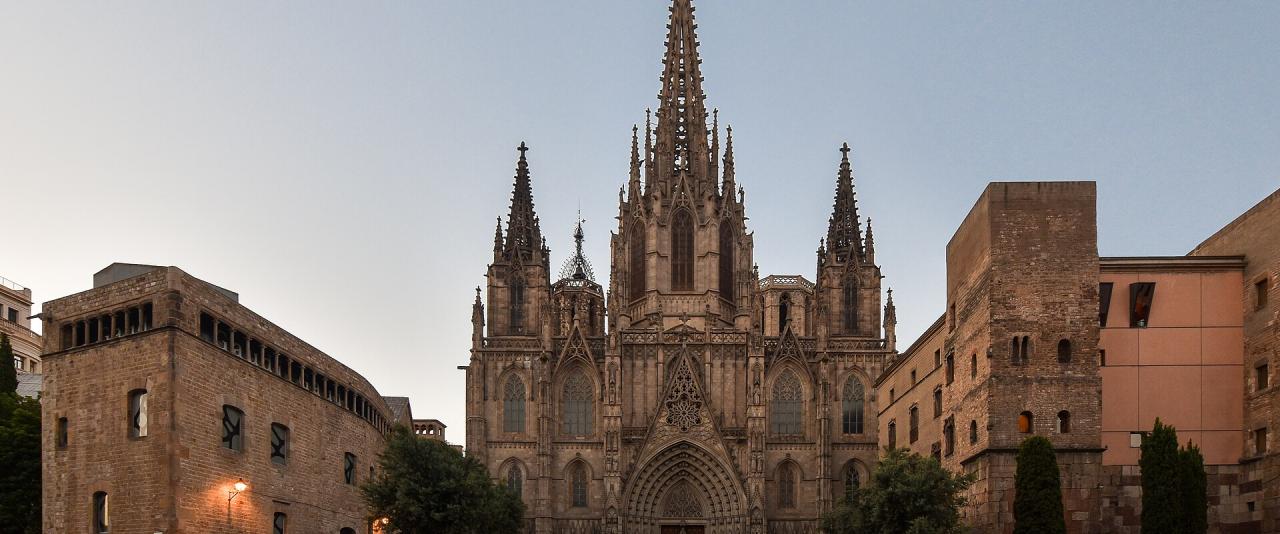
Barcelona Cathedral (the Cathedral of the Holy Cross and Saint Eulalia) was built mainly between the 13th and 15th centuries, while its main façade was finished only in the late 19th century. The cloister, with its palm trees, fountain and a flock of thirteen white geese, is the quiet part. The geese are traditionally linked to Saint Eulalia, the city's co-patron, who according to tradition was 13 when she was martyred. Entry arrangements and fees vary by time of day, so check the cathedral's website before you go.
Carrer del Bisbe and the Roman Columns
From the cathedral, Carrer del Bisbe leads towards Plaça de Sant Jaume. Its carved stone bridge looks medieval but was built in 1928, designed by architect Joan Rubió i Bellver as part of the neo-Gothic reworking of the quarter. Just east of here, in the courtyard of the Centre Excursionista de Catalunya at Carrer del Paradís 10, stand four Corinthian columns of the Roman Temple of Augustus. They are tucked inside a modest doorway that many visitors walk straight past, and the space is usually free to enter during opening hours.
Plaça del Rei and the City History Museum
Plaça del Rei is a small enclosed square framed by the medieval royal palace, the Saló del Tinell and the Chapel of Santa Àgata. Underneath it, the Barcelona History Museum (MUHBA) has opened up a large excavated area of Roman Barcino, including streets, a laundry, fish-salting tanks and a winery, which you walk over on raised platforms. It is the best single place to understand how the city grew. Nearby, along Plaça de Ramon Berenguer el Gran and Carrer de la Tapineria, you can see long stretches of the Roman walls incorporated into later buildings.
Plaça de Sant Felip Neri
West of the cathedral, a narrow passage opens into Plaça de Sant Felip Neri, a small square with a fountain and a church whose façade is scarred by shrapnel. On 30 January 1938, during the Spanish Civil War, bombs dropped by Italian aircraft supporting Franco's side struck the square, killing dozens of people, many of them children sheltering in the church. A plaque records the event. The square is a school playground at some hours and a quiet place to sit at others; keep voices low out of respect for both.
El Call, the Medieval Jewish Quarter
The lanes around Carrer del Call, Carrer de Sant Domènec del Call and Carrer de Marlet formed the Jewish quarter until the 1391 massacre and later expulsion. Few physical traces remain, and the narrow streets are easy to miss. A medieval Hebrew inscription stone is set into a wall on Carrer de Marlet, and a small interpretation centre run by the city history museum covers the community's story. The Sinagoga Major on Carrer de Marlet is presented as the remains of a medieval synagogue, though historians debate the identification.
Plaça Reial and Practical Tips
Finish at Plaça Reial, an arcaded 19th-century square just off La Rambla, where the two six-armed lampposts are early works by Antoni Gaudí. It is lively at night but loud, and restaurant terraces here are aimed at visitors.
A few practical points:
- Go early. Before about 10 am the lanes are close to empty, and the light in the narrow streets is better.
- Watch your belongings. Pickpocketing is a known problem in the old town and on La Rambla; carry bags in front and keep phones out of back pockets.
- Wear flat shoes. Paving is uneven and many lanes are stepped or sloped.
- Respect residents. People live above every street here, and the city has introduced rules for large tour groups in the old town. Keep noise down late in the evening.
- Use the free sights. The Roman columns, the walls, Sant Felip Neri and the outside of the cathedral cost nothing, so a good visit can be done on a small budget.