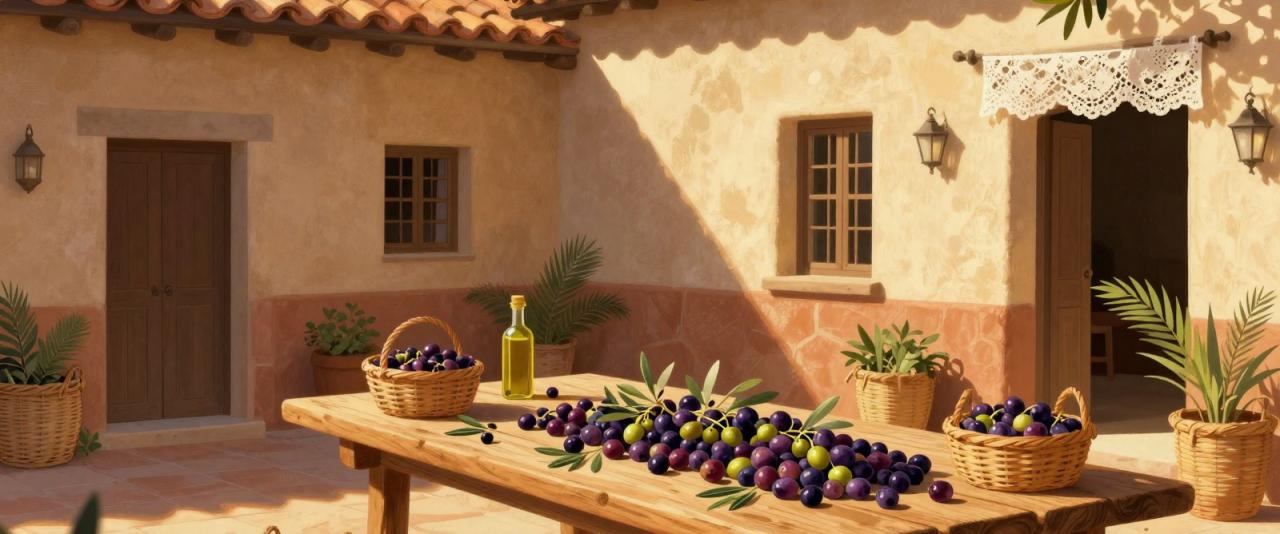
When the Harvest Happens
In the south of Córdoba province, olive picking runs from late October or November into January, depending on the variety, the weather and how ripe the fruit is. The regulating council of the Priego de Córdoba protected designation of origin (PDO) gives a harvest window from the second half of October to the end of December or January. Mills (almazaras) work long hours in these weeks, pressing fruit within hours of picking, and the first oils of the season, often called early-harvest or new oil, reach shops and bars from November.
For visitors this is the best time to see the industry working rather than reading about it: tractors queue at the cooperatives, nets lie under the trees, and towns that are quiet in summer smell of crushed olives.
The Two Best-Known Designations: Priego de Córdoba and Baena
Córdoba province has four olive oil designations: Baena, Lucena, Montoro-Adamuz and Priego de Córdoba. The first two are the most visited.
- Priego de Córdoba PDO covers about 29,500 hectares in the municipalities of Almedinilla, Carcabuey, Fuente Tójar and Priego de Córdoba, inside the Sierras Subbéticas Natural Park. Its council was set up in 1995 and the designation has been registered with the EU since 1999. It protects extra virgin oil from the Picudo (about 60 per cent), Hojiblanca and Picual varieties, and only glass, ceramic and tin packaging is accepted. Bottles carry a numbered back label from the council.
- Baena PDO covers Baena, Cabra, Doña Mencía, Luque, Nueva Carteya and Zuheros. Its regulation dates from 1995, and the permitted varieties are Picudo (also called Carrasqueño de Córdoba), Lechín, Chorrúo or Jardúo, Pajarero, Hojiblanca and Picual.
The two zones are neighbours, so a single base can cover both.
What You Can Actually Do
Olive oil tourism (oleoturismo) in the area is built around a handful of activities:
- Mill visits. Several mills in both PDOs run guided tours, usually by appointment, showing the reception of fruit, the decanters and the storage cellars. In harvest season you see the line running; outside it you see clean, idle machinery. Book ahead and ask whether the mill is pressing on the day.
- Tastings. A guided cata teaches the three positive attributes in a tasting panel: fruitiness (frutado), bitterness (amargo) and pungency (picante), the peppery catch at the back of the throat that is strongest in fresh oil.
- Breakfast with oil. A local mollete or toast with new oil, salt and sometimes tomato is the simplest way to taste the season.
- Grove walks. Some farms let visitors walk the trees or watch picking, which today is mostly done by shaking machines and hand rakes onto nets.
Priego de Córdoba also organises an oil month around the new harvest, with tastings, walks and activities in the four PDO towns. Recent editions have run from late November to late December, but the dates change each year, so check the town council and PDO council announcements before you plan around it.
Towns Worth a Stop
Priego de Córdoba is the base most visitors choose: a Baroque town with the Fuente del Rey fountain and a whitewashed old quarter, the Barrio de la Villa. Zuheros, a hilltop village under a castle in the Baena PDO zone, is a short drive away and sits by the Cueva de los Murciélagos, a cave with prehistoric remains. Baena itself is an agricultural town of about 19,000 people around 60 km from Córdoba city, with a hilltop old quarter around the church of Santa María la Mayor. Luque and Cabra fill in the loop.
Between them runs the Vía Verde de la Subbética, a converted railway line that is part of the longer Vía Verde del Aceite greenway between Jaén and Córdoba provinces. It is flat, signposted and passes through olive groves for most of its length, making it a good way to walk or cycle the landscape in cool winter weather.
Getting There and Getting Around
Córdoba city is on the high-speed rail line from Madrid and Seville, and it is the practical arrival point. From there the Subbética towns are roughly an hour or more by road. Buses link Córdoba with Priego and Baena, but services to smaller villages are limited, and mills are often outside town, so a hire car is the realistic option for a harvest trip.
Winter here is mild by day and cold at night, with possible rain and occasional frost at altitude. Short days mean planning visits for late morning and early afternoon.
Buying and Carrying Oil Home
New-season oil is at its most aromatic in the first months after pressing; store it away from light and heat. Look for the PDO back label if you want a guaranteed origin. Oil in tins travels better than glass in checked luggage, and liquids over 100 ml cannot go in cabin bags on most flights, so pack it in the hold or ship it from the producer.