







Roman Amphitheatre of Tarraco
- Admission
- Book via official website
- Where
- Tarragona, Catalonia
- Directions
- Directions
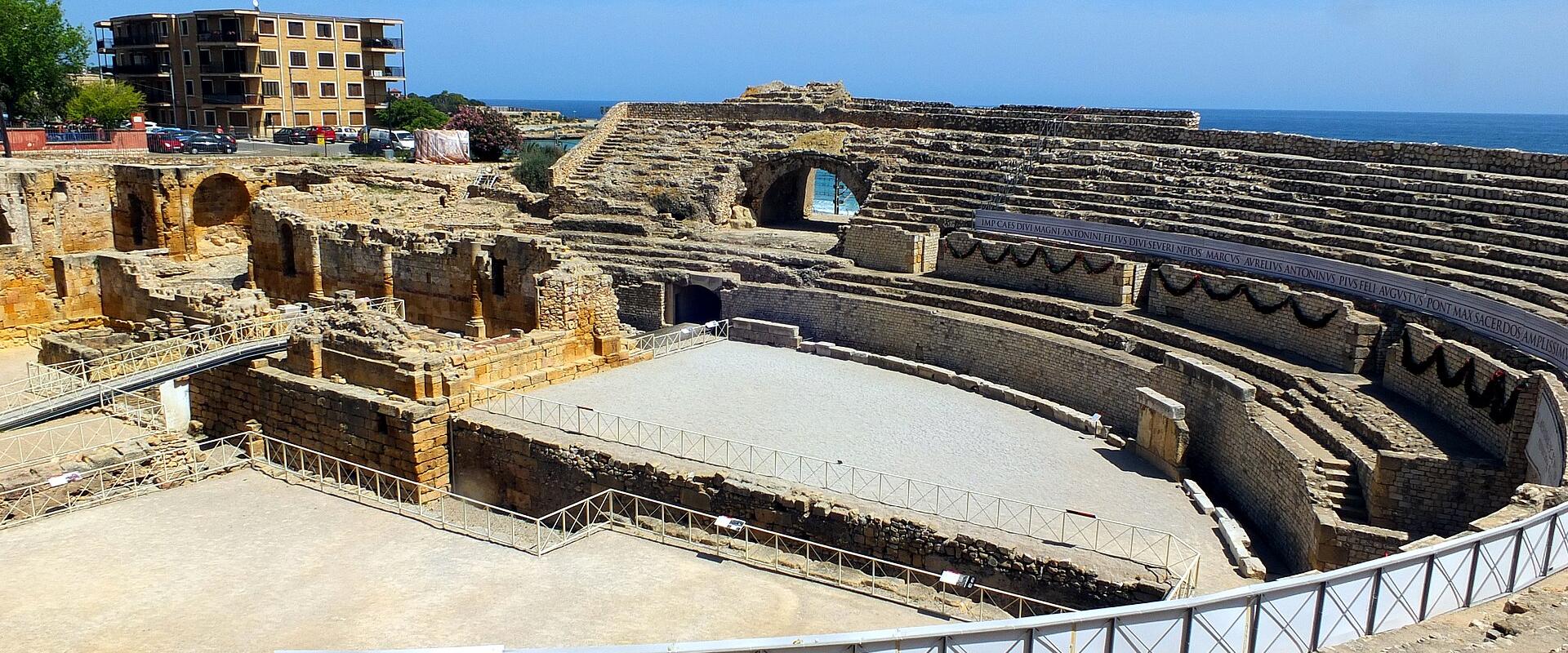
The Roman Amphitheatre of Tarraco is one of the most photogenic monuments in Tarragona, set in a park on the slope that falls toward the Mediterranean, with the sea and the beach just beyond the stone seating. It was built in the second century AD, when Tarraco was the capital of the Roman province of Hispania Citerior and one of the great cities of the western empire. The oval arena was designed for gladiator fights, wild-beast hunts and executions, and could hold roughly fourteen thousand spectators, a sign of the city's size and wealth. Part of the seating was carved out of the natural rock, and the rest rested on vaults built of stone.
The amphitheatre belongs to the Archaeological Ensemble of Tarraco, which UNESCO named a World Heritage Site in 2000, along with the circus, the forum, the Roman walls, the theatre and several other monuments scattered around the city. Together they show how a Roman provincial capital was laid out, with entertainment buildings, public spaces and defensive walls on the hilltop and along the coast. The amphitheatre is the most dramatic of the group because of its seaside location.
The site also has an important Christian history. In the year 259, during the persecution under the emperor Valerian, the bishop Fructuosus and his deacons Augurius and Eulogius were burned alive in the arena. After the empire became Christian, a church was built in the arena to commemorate the martyrs, first in the Visigothic period, and later a Romanesque church, Santa Maria del Miracle, was raised on the spot in the twelfth century. The foundations of these churches are still visible in the middle of the arena, which gives the site a layered quality and makes it quite unlike other Roman amphitheatres.
Visitors can walk around the arena, look at the surviving rows of seats and see the passages under the stands where animals and gladiators waited. Panels explain the history and the use of the building. The sea views from the top row are among the most memorable in Tarragona, and the park around the amphitheatre has trees, lawns and benches. The site is compact, and a visit takes between thirty and sixty minutes.
The amphitheatre lies below the old town, a short walk from the Balcó del Mediterrani and the Roman Walls, and the National Archaeological Museum of Tarragona holds finds from the city. It suits history lovers, families and photographers, and combines well with a day of walking through the Roman city. Tickets and guided tours are available through the official sites, and opening hours vary by season.
More photos coming soon
Admission Fees
- Admission
- Book via official website
Hours and prices change, especially out of season. Check with the venue before you go.

Questions people ask
Quick Facts
Best Time to Visit
May through June and September offer warm, dry weather ideal for exploring the city.