Why Look Beyond the Basilica
The Sagrada Família draws most of the attention, and in 2026 it has had more than usual: the Tower of Jesus Christ was structurally completed in February 2026, making the basilica the tallest church in the world at 172.5 metres, and it was inaugurated on 10 June 2026, the centenary of Antoni Gaudí's death. But the basilica is only one of seven Gaudí works on the UNESCO World Heritage list "Works of Antoni Gaudí" (inscribed in 1984, extended in 2005). The others are Park Güell, Palau Güell, Casa Milà, Casa Vicens, Casa Batlló and the crypt at the Colònia Güell. Seeing a few of them shows how his style developed over four decades, from colourful early houses to the structural experiments of his later years.
Casa Vicens: Where It Started
Casa Vicens in the Gràcia district was Gaudí's first major house, built between 1883 and 1888 as a summer residence. It looks very different from his famous later work: square-ish volumes covered in green and white tiles with a marigold pattern, brick, and Moorish-inspired details. The house opened as a museum in 2017, and it is a good first stop because it shows his starting point before the flowing curves took over. Gràcia's small squares and local streets around it are pleasant for a coffee afterwards.
Palau Güell: The Early City Palace
Palau Güell, built between 1885 and 1890 for Gaudí's patron Eusebi Güell, sits on Carrer Nou de la Rambla, a few steps off La Rambla. From the street it looks heavy and closed, but inside is a tall central hall lit from a perforated dome, and on the roof are chimneys covered in broken tile, an early version of the trencadís mosaic technique he used at Park Güell. It is usually less crowded than the Passeig de Gràcia houses, which makes it a sensible choice if you only have time for one interior.
Passeig de Gràcia: Casa Batlló and La Pedrera
The two most visited houses after the basilica are a short walk apart on Passeig de Gràcia. Casa Batlló (1904–1906) was a remodelling of an existing building; its façade of coloured glass, bone-like columns and a scaled roof often read as a dragon. Casa Milà (1906–1912), known as La Pedrera ("the stone quarry"), is a wavy stone apartment block with no load-bearing façade walls, and its rooftop of sculpted chimneys and stairwell exits is the highlight of a visit.
Both run timed tickets with several price tiers and often sell out at popular hours, so book online on the official sites a few days ahead. If budget or time is tight, the façades can be compared from the pavement for free, and the area around them also has buildings by Gaudí's contemporaries, such as Casa Amatller by Josep Puig i Cadafalch right next to Casa Batlló.
Park Güell
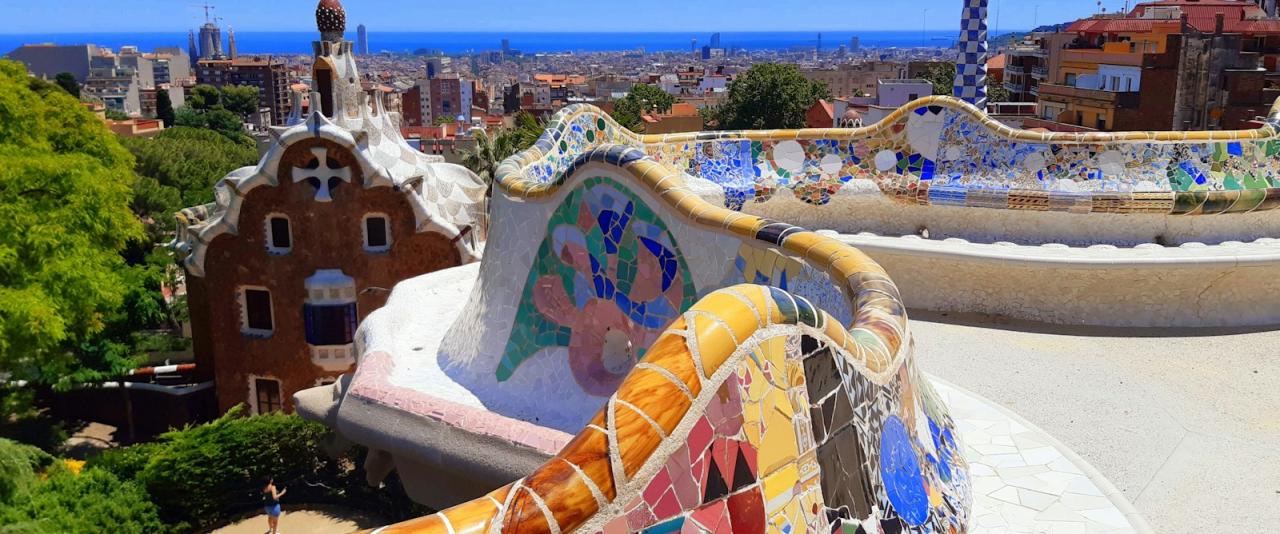
Park Güell (1900–1914) began as a planned housing estate on the hillside above Gràcia that never sold, and it became a public park. The famous parts, including the mosaic dragon on the entrance stairway, the hall of columns and the long serpentine bench on the main terrace, are in the Monumental Zone, which requires a timed ticket bought in advance. The rest of the park, with its stone viaducts and paths up to viewpoints over the city, is free to walk.
The park is on a steep hill. The nearest metro stops (Lesseps and Vallcarca on line L3) involve an uphill walk with escalators on part of the route, and several bus lines stop closer to the gates. Morning entry slots are cooler in summer.
Lesser-Known Works Worth the Detour
- Colònia Güell crypt in Santa Coloma de Cervelló, about 20 km west of the city and reached by FGC train from Plaça d'Espanya. Built between 1908 and 1914 for a textile workers' colony, it is where Gaudí tested the leaning columns and hanging-chain models he later used for the Sagrada Família. The church above it was never built.
- Bellesguard (1900–1909), a neo-Gothic house on the slopes of Tibidabo built on the site of a medieval royal residence, which can be visited.
- Güell Pavilions (1884–1887) in Pedralbes, known for the wrought-iron dragon gate that is visible from the street.
- Casa Calvet (1898–1900) near Plaça de Catalunya and the Teresian College (1888–1889) in Sant Gervasi, which are private or in use and best seen from outside.
- The lampposts in Plaça Reial, designed in 1878 and among his first commissions from the city, free to see on any walk through the old town.
Planning a Gaudí Route
A workable two-day split is Passeig de Gràcia and Palau Güell on one day, with Park Güell and Casa Vicens (both in or near Gràcia) on another. The Colònia Güell crypt needs a half-day on its own because of the train journey. Interiors are where most of the cost lies, so choose two or three that interest you most rather than buying every ticket. Check the official websites of each building for current opening hours, as schedules change by season and special events in the 2026 centenary year have affected access at some sites.