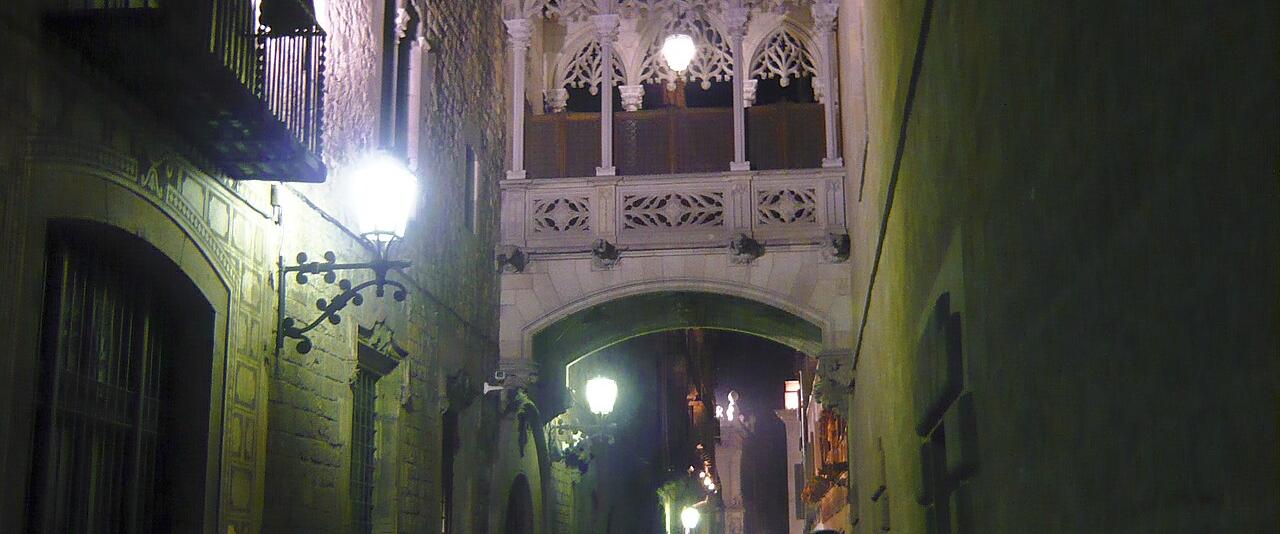
Barcelona is the city of Gaudí, beaches inside the city limits and late dinners in the Gothic Quarter. It is also the city where a mob destroyed the Jewish quarter in 1391, where a conquering king pulled down a thousand houses to build a fortress to watch the city, and where anarchists threw bombs into an opera house. In the 20th century it was bombed from the air for three days, a president of Catalonia was shot in a castle moat on Montjuïc, and the last man garroted in Spain died in a city prison in 1974.
Barcelona has been better than many cities at marking these places. Most of the stories here left something you can stand in front of: a plaque on a narrow street of the old Call, an eternal flame beside a Gothic church, a church façade still pitted by bomb fragments, a memorial set into the pavement of La Rambla. This guide follows them in order, from the Middle Ages to the present, and tells you where to find each one. The last section has a walking route and some notes on visiting the recent memorials with care.
1391: The Destruction of the Call
For centuries Barcelona had one of the most important Jewish communities in Iberia, living in the Call, the narrow streets between the cathedral and Plaça Sant Jaume. In the summer of 1391 a wave of anti-Jewish violence spread from Seville across the Spanish kingdoms. It reached Barcelona on 5 August. Over four days, crowds attacked the Call, killed those who resisted and forced survivors to choose between baptism and death. Many Jews took refuge in the royal Castell Nou, but by October most of the survivors had converted. The community never recovered.
The best contemporary figure for the dead comes from a letter by the rabbi and philosopher Hasdai Crescas, whose own son was among them: about 150. Later historians give estimates of up to several hundred.
 Carrer de Marlet in the old Call. A replica of a medieval Hebrew foundation stone is set into the wall at number 1. Image: derivative work: — Malik Shabazz (talk • contribs) Call.jpg: Mariusmm, CC BY-SA 3.0, via Wikimedia Commons.
Where to see it today: at Carrer de Marlet 1, a stone in the wall bears a Hebrew inscription: "Pious foundation of Rabbi Samuel ha-Sardí; his light shines forever." It is a 1981 replica; the original, found in 1820, is in the city history museum (MUHBA). A few doors along, at Marlet 5, a small museum presents a medieval cellar as Barcelona's main synagogue. Historians dispute that identification, so treat it as a possible site rather than a certain one. The MUHBA El Call centre on Placeta de Manuel Ribé tells the history of the quarter.
The Inquisition in the Royal Palace
In 1487 Barcelona was forced to accept the new Spanish Inquisition, against the objections of the city's own authorities. The tribunal moved into part of the Palau Reial Major, the medieval royal palace beside the cathedral, which became known as the Palace of the Inquisition. It had its own cells. The first public procession of "reconciled" converts, people who had confessed to secretly practising Judaism, took place the same year.
How many people the Barcelona tribunal condemned is unknowable. In 1820, during a liberal revolution, a crowd stormed the palace, freed the prisoners and threw the archives out of the windows. The Inquisition was finally abolished in 1834.
 The coat of arms of the Holy Office, still on the wall of the former Inquisition wing, now the Museu Frederic Marès. Image: Enric, CC BY-SA 4.0, via Wikimedia Commons.
Where to see it today: on the façade of the Museu Frederic Marès, Carrer dels Comtes 6–10, beside the cathedral, look up for the stone coat of arms of the Holy Office. It is easy to walk past.
1714: The Fall of the City
Barcelona backed the losing side in the War of the Spanish Succession. Philip V's army besieged the city for more than a year, and on 11 September 1714 it fell after a final assault. The defenders who died that day were buried in the parish cemetery beside the church of Santa Maria del Mar. Catalonia lost its own institutions, and General Josep Moragues, one of the leaders of the resistance, was executed in 1715; his head was displayed in an iron cage over one of the city gates for 12 years.
 The final assault on Barcelona in 1714, from an 18th-century engraving by Jean Rigaud. Image: J. Rigaud (1659-1743), CC0, via Wikimedia Commons.
Philip then built the Ciutadella, a star-shaped fortress designed to control the city rather than defend it. To make room, about 1,000 houses in the La Ribera neighbourhood were demolished, around a sixth of the city. The fortress was torn down from 1869, and its grounds became the Parc de la Ciutadella. The 11 September defeat became Catalonia's national day, the Diada.
 The Fossar de les Moreres at night, with the red steel memorial and the side of Santa Maria del Mar. Image: Kent Wang, CC BY 4.0, via Wikimedia Commons.
Where to see it today: the Fossar de les Moreres, beside Santa Maria del Mar, is the former cemetery, paved over in 1816 and turned into a memorial square. A curved red steel monument with an eternal flame, added in 2001, carries a verse that says no traitor is buried there. Two minutes away, under the 19th-century iron roof of the El Born market, the excavated streets and houses of the neighbourhood demolished for the Ciutadella lie open below the walkways; the centre is free, but the archaeological site can only be seen on a guided tour.
 The excavated streets of 1700 Barcelona under the old Born market. Image: Enric, CC BY-SA 4.0, via Wikimedia Commons.
The Garrote and the Last Public Execution
For centuries Barcelona executed people in public, latterly by the garrote, an iron collar tightened with a screw until it broke the neck or strangled the victim. The painter Ramon Casas showed one in the 1890s, with a vast crowd gathered in front of the city prison.
 Garrote vil by Ramon Casas: a public execution outside the Reina Amàlia prison in the 1890s. Image: Ramon Casas, Public domain, via Wikimedia Commons.
The last public execution in Barcelona took place on 15 June 1897, when Silvestre Lluís was garroted at 9 in the morning at the Reina Amàlia prison. After that, executions were carried out inside prison walls.
Where to see it today: the Reina Amàlia prison was demolished; its site is now Plaça de Folch i Torres in the Raval. The Casas painting hangs in the Museo Reina Sofía in Madrid.
1893–1909: The City of Bombs
In the 1890s Barcelona was the most industrial city in Spain and a centre of anarchism, and the conflict between factory owners and workers turned violent. On 7 November 1893, during the second act of Rossini's William Tell at the Liceu opera house, the anarchist Santiago Salvador threw two bombs from the upper gallery into the stalls. One exploded; at least 20 people were killed. The second landed on the body of a woman and did not go off. Salvador was garroted the following year.
 The Liceu bombing on the cover of the French Le Petit Journal, November 1893. Image: Unknown authorUnknown author, Public domain, via Wikimedia Commons.
On 7 June 1896 a bomb was thrown into a Corpus Christi procession on Carrer dels Canvis Nous, killing 12. The authorities arrested hundreds of anarchists and radicals and held them in Montjuïc castle, where confessions were extracted under torture. Five men were shot in the castle moat in May 1897. The trials caused an international outcry. The city later picked up the nickname "Rosa de Foc", the rose of fire.
In July 1909 the call-up of reservists to fight in Morocco set off the Tragic Week (Setmana Tràgica). Over a week of riots and street fighting, about 80 churches, convents and religious schools were burned, and more than 100 people died. Of the 17 death sentences that followed, five were carried out. One of the executed was Francesc Ferrer i Guàrdia, the founder of a secular school movement, shot at Montjuïc on 13 October 1909 on very thin evidence. He died calling out that he was innocent.
 The burned cloister of the convent of the Jerònimes after the Tragic Week, 1909. Image: Adolf Mas i Ginestà, Public domain, via Wikimedia Commons.
Where to see it today: the Liceu is on La Rambla. Inside the Sagrada Família, on the Rosary portal Gaudí designed in 1899, a demon hands an Orsini bomb, the type thrown in the Liceu, to a worker. A statue of Ferrer i Guàrdia, a replica of a 1911 Brussels monument, stands on Avinguda de l'Estadi near the Olympic stadium on Montjuïc.
1917–1923: The Gunmen's War
From 1917 Barcelona's employers hired gunmen to kill trade union leaders, and anarchist militants shot back at employers, managers and police. The period is remembered as pistolerisme. About 424 people were killed in the city between 1918 and 1923, by the most cited count.
The best-known victim was Salvador Seguí, "el Noi del Sucre" (the sugar boy), the most influential leader of the anarcho-syndicalist union CNT, who argued for negotiation over violence. On 10 March 1923 he was shot by employers' gunmen at a street corner in the Raval, together with his companion Francesc Comas, who died days later.
 The plaque at Carrer de Sant Rafael 26 marking the murder of Salvador Seguí in 1923. Image: Enric, CC BY 4.0, via Wikimedia Commons.
Where to see it today: a ceramic plaque at Carrer de Sant Rafael 26, on the corner of the Rambla del Raval, marks the spot. It was put up in 2019.
1936–1939: Bombs From the Sky
During the Spanish Civil War, Barcelona was the Republic's last great city and one of the first in Europe to be bombed systematically from the air. Italian aircraft flying from Mallorca for Franco carried out the worst raids. Over three days, from 16 to 18 March 1938, they struck the city 18 times at roughly three-hour intervals. Nearly 1,000 people were killed, possibly up to 1,300.
 Bombs exploding over Barcelona on 17 March 1938, photographed by the Italian air force. Image: Aviazione Legionaria delle Baleari, Public domain, via Wikimedia Commons.
On the morning of 30 January 1938, a bomb fell on Plaça de Sant Felip Neri in the Gothic Quarter. Children from the parish school had taken shelter in the church basement; it collapsed on them, and the raids went on for more than two hours, hampering the rescue. 42 people died that morning, about 20 of them in the basement. For decades Franco's propaganda claimed the marks on the church façade were bullet holes from firing squads that had shot priests. They were made by the bombs.
 The church of Sant Felip Neri, its façade still marked by the 1938 bombing. Image: Enfo, CC BY-SA 3.0, via Wikimedia Commons.
Barcelonans dug more than 1,300 air-raid shelters; the city's archaeologists are still finding new ones. Inside the city, the war had its own violence: in May 1937, anarchists and the POUM fought the Communists and Catalan government in street battles that killed about 500 people. George Orwell, who had come to fight with the POUM, described them in Homage to Catalonia.
Where to see it today: Plaça de Sant Felip Neri is one of the quietest squares in the Gothic Quarter; a plaque and information panels explain the scars, and the square still has a school. Refugi 307, at Carrer Nou de la Rambla 175 in Poble-sec, is a shelter tunnel dug by local residents, open on guided weekend tours run by MUHBA (booking required). The anti-aircraft battery on the Turó de la Rovira hill, now a famous sunset viewpoint, was later covered by a shanty town that survived until 1990; some of its tiled floors are still visible.
1939–1975: Franco's Executions
After Barcelona fell in January 1939, the dictatorship took its revenge. At the Camp de la Bota, a beach on the edge of the city, more than 1,700 people were shot between 1939 and 1952. Their bodies, and those of thousands of other victims, were buried in a quarry in Montjuïc cemetery.
The most famous victim was Lluís Companys, the President of Catalonia, who had fled to France. The Gestapo arrested him in 1940 and handed him to Franco. After a summary court-martial whose outcome was never in doubt, he was shot at dawn on 15 October 1940 in the moat of Montjuïc castle. Catalans remember him as the only democratically elected president in Europe to have been executed.
 The Fossar de la Pedrera memorial in Montjuïc cemetery, where Franco's victims were buried in an old quarry. Image: Aniol, CC BY-SA 4.0, via Wikimedia Commons.
The dictatorship's political police ran their interrogations from the headquarters at Via Laietana 43, remembered for torture. Spain declared it a place of democratic memory in July 2026, but it remains a working National Police station.
The last people executed by garrote in Spain died on the same morning, 2 March 1974: the young anarchist Salvador Puig Antich in Barcelona's Model prison, and a man called Heinz Ches in Tarragona. Franco died the following year.
 Puig Antich's cell in La Model, preserved after the prison closed in 2017. Image: Canaan, CC BY-SA 4.0, via Wikimedia Commons.
Where to see it today: the Fossar de la Pedrera memorial, with Companys's tomb, is in Montjuïc cemetery. At Montjuïc castle a stone marks the spot in the moat where he died; the castle is open daily (free on Sunday afternoons and the first Sunday of the month). At the Fòrum, the Parapet wall lists the names of those shot at the Camp de la Bota. The Model prison, in the Eixample, ran free visits until July 2026 while its conversion began; check its website before going.
1987 and 2017: Terror
On 19 June 1987 a car bomb planted by the Basque separatist group ETA exploded in the car park of the Hipercor supermarket on Avinguda Meridiana. It killed 21 people, the deadliest attack in ETA's history.
On the afternoon of 17 August 2017, a van was driven at speed down the central walkway of La Rambla, hitting pedestrians for about 500 metres before it stopped on the Joan Miró pavement mosaic at Pla de l'Os. Thirteen people were killed on La Rambla, and 16 died in total in the attacks in Barcelona and in Cambrils, further down the coast, the next day.
 Flowers and candles around the Miró mosaic on La Rambla in the days after the 2017 attack. Image: Amadalvarez, CC BY-SA 4.0, via Wikimedia Commons.
Where to see it today: a 12-metre bronze strip set into the pavement beside the Miró mosaic on La Rambla, inaugurated in 2019, carries an inscription in four languages: "May peace shield you, city of peace." Most visitors walk over it without noticing. The Hipercor victims are remembered by a memorial stone on Avinguda Meridiana.
Today's Shadows
Barcelona's present-day problems are the ones visitors are most likely to meet.
- Pickpockets. The city is not officially Europe's pickpocket capital, but theft is a real risk: Eurostat figures put it at almost three times the Spanish average. Thefts have been falling since 2024, but La Rambla, the metro, the beaches and the queues at the big sights remain the hot spots. Phones on café tables are a favourite target.
- Overtourism and protests. In July 2024 thousands of residents marched against mass tourism, and a few sprayed diners with water pistols. The city plans to stop renewing all of its roughly 10,000 tourist apartment licences in November 2028, raised its tourist tax in April 2026 and is cutting cruise-terminal capacity.
- The Raval. The district west of La Rambla was nicknamed the Barrio Chino in 1925, after its brothels and cabarets rather than any Chinese community, and the writer Jean Genet lived rough there in the early 1930s. Some streets, such as Carrer d'en Robador, are still known for street prostitution and drug flats, the narcopisos.
- Street beer sellers. The lateros who sell cans on beaches and in squares are illegal, and since February 2026 buyers can be fined too.
 Carrer d'en Robador in the Raval. Image: Ximonic (Simo Räsänen), CC BY-SA 4.0, via Wikimedia Commons.
How to visit: keep phones and bags out of reach, don't buy from street sellers, book the Sagrada Família and Park Güell on the official websites, and remember that the people whose balconies line the old town have to sleep. Don't photograph sex workers in the Raval.
How to See Dark Barcelona Respectfully
A self-guided walk, about 4 km. Start at the Miró mosaic on La Rambla and find the 2017 memorial strip, then cross to the Liceu. Walk into the Gothic Quarter to Plaça de Sant Felip Neri and its scarred church, then on to Carrer de Marlet and the Call. Pass the cathedral to the Museu Frederic Marès and the Inquisition coat of arms. Continue across Via Laietana to the Fossar de les Moreres and Santa Maria del Mar, and finish at El Born. To add the Raval, start instead at Carrer de Sant Rafael 26 and Seguí's plaque.
Further afield:
- Montjuïc castle, the Fossar de la Pedrera and the Ferrer i Guàrdia statue on Montjuïc.
- Refugi 307 in Poble-sec, at weekends.
- The Turó de la Rovira bunkers in El Carmel, best at sunset (closed at night).
- The Model prison in the Eixample, if visits have resumed.
- The Parapet names wall at the Fòrum.
Dates the city remembers:
- 30 January: the Sant Felip Neri bombing.
- 17 August: the 2017 attack, with a ceremony at the Miró mosaic.
- 11 September: the Diada, with crowds at the Fossar de les Moreres.
- 15 October: the execution of Lluís Companys, with flowers at Montjuïc.
A few ground rules. Sant Felip Neri is a school square where children were killed; keep your voice down and don't climb on the fountain. Don't stand on the 2017 memorial strip for photos. At the Fossar de les Moreres, especially around 11 September, you are in a place that matters deeply to many Catalans.

,_escut_del_Tribunal_del_Sant_Ofici.jpg)


,_interior.jpg)


.jpg)


