How Spain's High-Speed Network Works
Spain has one of the largest high-speed rail networks in Europe, and for most trips between big cities the train beats flying once you count airport transfers and security. Renfe, the state-owned operator, runs the AVE (Alta Velocidad Española) brand, its low-cost sister brand Avlo, and the slower long-distance (Alvia, Intercity) and regional services that fill in the gaps.
Since the market opened to competition in 2021, two private operators share the busiest high-speed corridors: Ouigo, owned by France's SNCF, and Iryo, a Spanish-Italian venture. The practical upshot is more departures and lower fares on routes such as Madrid to Barcelona, Madrid to Valencia, Madrid to Seville and Madrid to Málaga. Smaller routes, and almost everything off the high-speed lines, remain Renfe-only.
Madrid to Barcelona: The Route Most People Search For
This is the flagship corridor. The fastest non-stop trains take about 2 hours 30 minutes, while services that stop at Zaragoza, Lleida or Tarragona (Camp de Tarragona station) take closer to three hours. In Barcelona, high-speed trains use Barcelona Sants. In Madrid, departures are split between Puerta de Atocha-Almudena Grandes and Chamartín-Clara Campoamor, and the station depends on the operator and the individual train, so read your ticket carefully rather than assuming Atocha.
Renfe AVE, Ouigo and Iryo all run on this route, with dozens of departures a day in each direction. Timetables shift from season to season, so check current schedules on the operators' own sites or a comparison platform before you plan connections.
Choosing Between Renfe, Ouigo and Iryo
All three operators run modern trains on the same tracks, so the main differences are price, luggage and comfort.
- Renfe AVE sells fares in tiers (the basic fare is the cheapest and least flexible; higher tiers add seat choice, changes and refunds). AVE has the widest network and is the only option for many destinations.
- Ouigo is the budget specialist. The headline fare is low but covers only a small bag; a cabin suitcase, seat selection and flexibility are paid extras.
- Iryo sits between the two, with several fare levels and a more premium on-board feel in its upper classes.
If you are travelling light, a low-cost fare is often the best value. With a large suitcase, add the luggage fee before comparing, because the cheapest headline price can end up close to a standard AVE ticket.
Booking Tips and Fares
Fares are dynamic: they rise as a train fills and as the departure date approaches. Booking a few weeks ahead usually gets you a much better price than buying on the day, and Friday and Sunday afternoons, holiday weekends and summer are the most expensive times to travel. Advance fares on the Madrid–Barcelona route can drop to the price of a meal, while last-minute standard tickets can cost many times more.
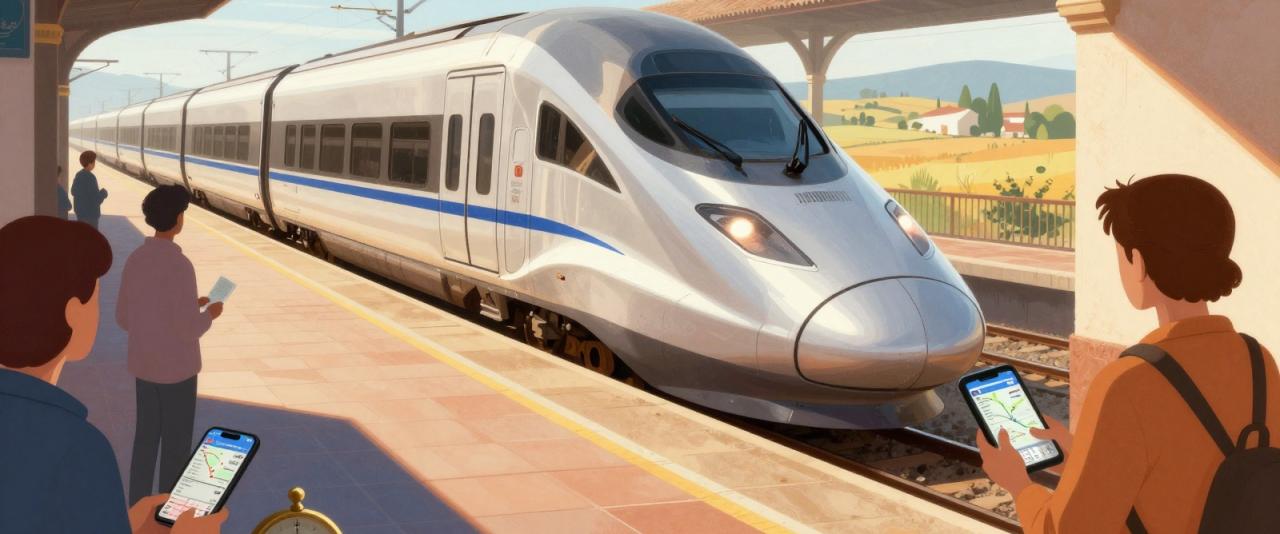
Book directly on renfe.com, ouigo.com or iryo.eu, or use a comparison site that shows all three operators side by side. The operators' apps let you keep your ticket on your phone; a QR code on screen is accepted at the gates. If you hold an Interrail or Eurail pass, you still need a seat reservation on AVE trains, and passes are generally not valid on Ouigo or Iryo.
At the Station: Security and Boarding
High-speed and long-distance trains in Spain board through a separate access area with a luggage scanner, a little like a quick airport check. It is usually fast, but at Madrid Atocha and Barcelona Sants at busy times the queue can take a while, so aim to arrive 20 to 30 minutes before departure. Gates close a few minutes before the train leaves and staff do not reopen them for late arrivals.
Check the departure boards for your train number rather than the destination name, because several trains to the same city may leave within minutes of each other from different platforms. Seats are assigned, and coach numbers are shown on the platform and on the train doors.
Luggage and Comfort on Board
Renfe's luggage allowance on AVE trains is generous compared with airlines, allowing a few pieces per passenger within a weight and size limit, and staff rarely weigh bags. The low-cost operators, including Renfe's own Avlo, are stricter and charge for larger bags. There are racks at the ends of each coach for suitcases and overhead shelves for smaller bags.
Trains have air conditioning, power sockets at most seats and a café car or trolley service on most AVE, Ouigo and Iryo services. Wi-Fi exists on many trains but can be patchy in tunnels and rural stretches, so download anything you need before boarding.
Beyond the High-Speed Lines
For destinations off the high-speed network, Renfe's Alvia and Intercity trains and the regional Media Distancia services take over. They are slower but scenic, for example through Galicia, Asturias or the Pyrenees foothills. Commuter networks (Cercanías in Madrid, Rodalies in Barcelona) cover airports and suburbs; many AVE and long-distance tickets include a free Cercanías connection on the same day, shown on the ticket. For journeys under about four hours by rail, the train is usually the most comfortable choice in Spain, and for cities linked by AVE it is often the fastest door to door.