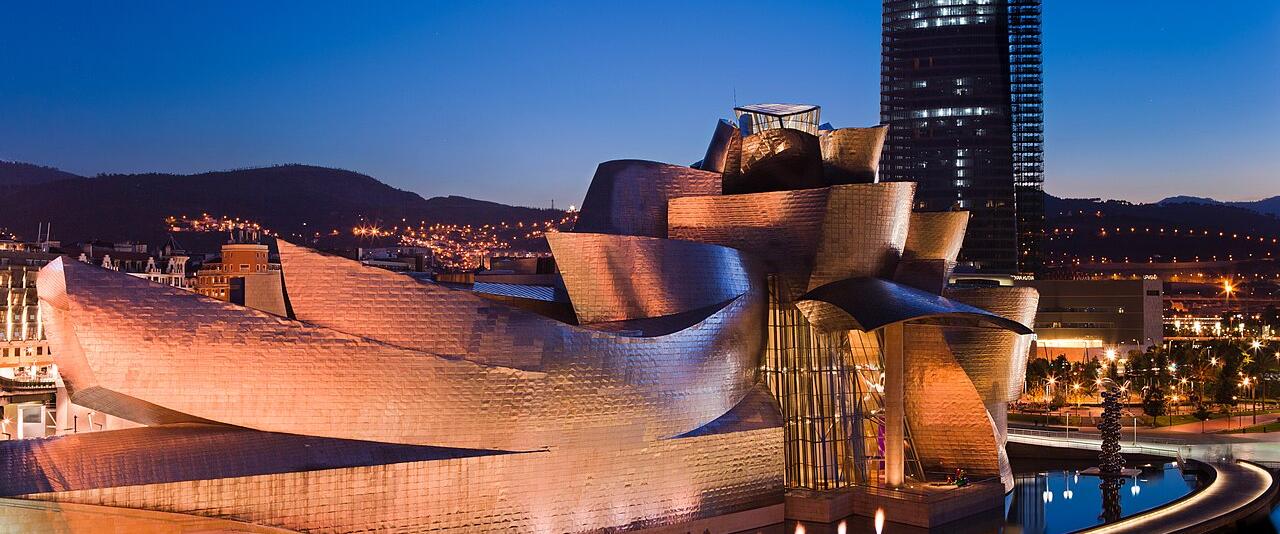
Bilbao is the city of the Guggenheim, and most visitors come for that titanium curve on the river. But the museum is only the last chapter of a longer story: a medieval river port that became the iron and shipbuilding capital of Spain, lost nearly everything in the industrial collapse of the 1980s and a catastrophic flood, and then rebuilt itself so completely that city planners around the world now talk about the "Bilbao effect".
This is Bilbao's bright side, in roughly the order it happened: the firsts it can claim, the comebacks, the people and the traditions. Every chapter ends with something you can go and see.
1300: A Port on the River
On 15 June 1300 the lord of Biscay, Diego López de Haro, granted a charter to "the town and port of Bilbao", a settlement on the river Nervión upstream from the sea. There had probably been people here before; the charter turned it into a chartered town with the right to trade. The old town grew around three streets, then seven: the Siete Calles, Somera, Artekale, Tendería, Belostikale, Carnicería Vieja, Barrenkale and Barrenkale Barrena. For centuries wool, iron and wine passed through its quays.
 Belostikale, one of the Siete Calles of the old town. Image: Zarateman, CC BY-SA 4.0, via Wikimedia Commons.
Where to see it today: walk the Siete Calles in the Casco Viejo, between the cathedral of Santiago and the river. Carnicería Vieja still carries the name of the medieval butchers' street.
1857–1902: Iron, Ships and Banks
In the 19th century the iron ore of the hills around Bilbao made the city rich. Mining, steelworks and shipyards lined the river, and the money built banks. The Banco de Bilbao was founded in 1857 and in 1868 moved into the Palacio de San Nicolás, still the registered office of its successor, BBVA. In 1902 three iron companies merged into Altos Hornos de Vizcaya, which became Spain's largest company for much of the 20th century, employing up to 40,000 people at its peak.
 The Palacio de San Nicolás, the Banco de Bilbao's home since 1868. Image: Galder Segurola, CC BY-SA 4.0, via Wikimedia Commons.
Where to see it today: the Palacio de San Nicolás on Plaza de San Nicolás, by the Arenal (exterior only). Down the river at Sestao, Blast Furnace No. 1, the last surviving furnace of Altos Hornos, stands about 80 metres high as a protected monument; you can see it from outside.
 Blast Furnace No. 1 at Sestao, the last of Altos Hornos de Vizcaya. Image: Yandrak, CC BY-SA 4.0, via Wikimedia Commons.
1893: The First Bridge That Flies
Near the mouth of the river, ships needed tall clearance, and a normal bridge would have blocked them. In 1893 the architect Alberto de Palacio solved it with something new: a gondola hanging from cables under a high steel span, carrying people and carts across the river while ships passed underneath. The Vizcaya Bridge, between Portugalete and Getxo, was the first bridge of its kind in the world. It was copied around the world, and it is the oldest transporter bridge still working. In 2006 UNESCO made it a World Heritage Site.
 The Vizcaya Bridge, the world's first transporter bridge, opened in 1893. Image: José Ligero Loarte, CC BY-SA 4.0, via Wikimedia Commons.
Where to see it today: take metro line 1 to Areeta or line 2 to Portugalete. The gondola crosses the river around the clock, for under a euro. For a few euros more, a lift takes you up to the walkway 45 metres above the water.
1898: A Club of Its Own
Athletic Club, founded in 1898, plays in red and white stripes and has a rule found almost nowhere else in professional football: it fields only players born in the Basque Country or trained at Basque clubs. It has never been relegated from Spain's top division, a record it shares only with Real Madrid and Barcelona.
When Athletic wins a major trophy, the team sails up the river on the gabarra, an old cargo barge. On 11 April 2024, after winning the Copa del Rey for the first time in 40 years, the barge sailed about 13 km from Getxo to the town hall, and by press estimates about a million people lined the banks.
 The gabarra carrying the Athletic team up the river on 11 April 2024. Image: Hiruka komunikazio-taldea, CC BY-SA 2.0, via Wikimedia Commons.
Where to see it today: San Mamés, the club's stadium, opened in 2013 on the riverbank, with a club museum inside. On match days, the bars of the old town fill with red and white.
 San Mamés and Bilbao from the air. Image: Mikel Arrazola, CC BY 3.0, via Wikimedia Commons.
1919: The Home of the Basque Language
Basque, or Euskara, is a language unrelated to any other in Europe. In 1919 the four Basque provinces founded Euskaltzaindia, the Royal Academy of the Basque Language, to standardise and protect it. Its first president was the priest and linguist Resurrección María de Azkue. Its headquarters are in Bilbao's old town. Today Basque is taught in schools and spoken by a growing share of the population, after decades in which it was suppressed.
 Plaza Nueva, the arcaded square where Euskaltzaindia has its headquarters. Image: Ekaitz Santazilia, CC BY 4.0, via Wikimedia Commons.
Where to see it today: Plaza Nueva (Plaza Barria), the arcaded 19th-century square in the Casco Viejo, where the academy's headquarters stand. On Sunday mornings it hosts a flea market, and the bars under its arches serve some of the city's best pintxos.
1929: The Market by the River
The Mercado de la Ribera, opened on 22 August 1929, stands on the riverbank beside the church of San Antón, where the town's market has been held since the Middle Ages. In 1990 Guinness recognised it as the most complete municipal food market. It was refurbished from 2009, and now has fish, meat and vegetable stalls on its upper floors and a pintxo hall below.
 The Mercado de la Ribera and the church of San Antón on the Nervión. Image: José Luis Filpo Cabana, CC BY 3.0, via Wikimedia Commons.
Where to see it today: the Mercado de la Ribera, at the river end of the Casco Viejo. Come in the morning for the stalls, at midday for pintxos.
1937: The Children of the Habana
In the spring of 1937, during the Spanish Civil War, Bilbao was under siege and being bombed. On 21 May 1937 the liner Habana sailed from Santurtzi, near the mouth of the river, with nearly 4,000 Basque children aboard, along with teachers, helpers and priests. Two days later they landed at Southampton.
The British government had refused to pay for them. Volunteers put up about 400 tents at a camp near Eastleigh, and a committee led by people like the MP Leah Manning raised the money for their care from public donations. The children were then spread across colonies around Britain. Most returned home after the war; some stayed for the rest of their lives. In all, more than 20,000 Basque children were evacuated to several countries.
 The ceramic mosaic of the Habana on the quay at Santurtzi. Image: Anitxu, CC BY-SA 4.0, via Wikimedia Commons.
Where to see it today: the port quay at Santurtzi (metro line 2), where a mosaic of the Habana, a statue of two children with a suitcase unveiled in 2022, and memorial plaques mark the place of departure.
1983: The Flood
On 26 and 27 August 1983, in the middle of the city's August fiesta, more than 500 mm of rain fell in parts of the region in 24 hours, and a high tide stopped the river from draining. The Nervión burst its banks. Water rose about three metres in the streets of the Casco Viejo and five metres inside the Teatro Arriaga. Across the region 34 people died and 5 were never found, and more than 5,000 were evacuated. It was the most costly flood in Spain's history for the next four decades.
What happened next is the bright side. The fiesta was cancelled, and thousands of volunteers from both banks of the river came to dig the mud out of the old town. The fiesta clubs, the konpartsak, became the backbone of the clean-up. The Teatro Arriaga, flooded to five metres, reopened in 1986.
 The plaque on the church of San Nicolás marking the height of the water on 26–27 August 1983. Image: pere prlpz, CC BY-SA 3.0, via Wikimedia Commons.
Where to see it today: look up at the wall of the church of San Nicolás, by the Arenal, for the oval bronze plaque marking how high the water came. Then cross the square to the Teatro Arriaga.
 The Teatro Arriaga at night, flooded in 1983 and reopened in 1986. Image: carlos corzo, CC BY-SA 3.0, via Wikimedia Commons.
1978 and Every August: Aste Nagusia
Bilbao's great festival, Aste Nagusia (Big Week), has been held every August since 1978, nine days of concerts, fireworks and street parties run largely by its 28 konpartsak. Its symbol is Marijaia, a giant doll with raised arms, created in 1978 by the artist Mari Puri Herrero.
Where to see it today: be in Bilbao in the second half of August. The opening rocket is fired from the balcony of the Teatro Arriaga.
1980s–1990s: Bottoming Out
By the mid-1980s heavy industry was collapsing. The shipyards closed one by one and Altos Hornos shut in 1996. Unemployment in the Basque Country reached about a quarter of the workforce. The river was polluted with industrial waste, and the banks were lined with abandoned yards.
The city answered with a long-term plan. A sanitation programme, begun around 1983, cleaned the river, at a cost of more than a billion euros. In 1992 the Spanish and Basque governments and the city set up Bilbao Ría 2000, an agency that bought old industrial land, cleaned it and sold it on to pay for new parks, promenades and transport.
The metro, designed by Norman Foster, opened in 1995. Its glass entrance canopies are nicknamed fosteritos. In 1997 the white footbridge Zubizuri, by Santiago Calatrava, crossed the river, and in 1999 the Euskalduna Palace, a concert hall and congress centre built to look like a ship, opened on the site of the old Euskalduna shipyard.
 The escalator tunnel of a Bilbao metro entrance, designed by Norman Foster. Image: Naotake Murayama from San Francisco, CA, USA, CC BY 2.0, via Wikimedia Commons.
 Calatrava's Zubizuri footbridge across the Nervión. Image: Basotxerri, CC BY-SA 4.0, via Wikimedia Commons.
 The Euskalduna Palace, on the site of the old shipyard. Image: Fred Romero from Paris, France, CC BY 2.0, via Wikimedia Commons.
Where to see it today: walk the riverside promenade from the old town to the Euskalduna. The Itsasmuseum, the maritime museum, stands on the site of the Euskalduna shipyard, with the old Carola crane still towering over it.
1997: The Guggenheim
On 18 October 1997 the Guggenheim Museum Bilbao opened on a former industrial site at Abandoibarra. Designed by Frank Gehry, its curving titanium form was hailed as one of the greatest buildings of its time. The Basque government paid for it, at a cost of about 100 million dollars, and by its own reckoning recovered the cost in taxes within a few years. It now draws about 1.3 million visitors a year.
Outside stand two famous sculptures: Puppy, a 12-metre West Highland terrier by Jeff Koons, covered in about 38,000 flowering plants that are replanted twice a year, and Maman, Louise Bourgeois's giant bronze spider, on the river side.
 Puppy by Jeff Koons, in front of the Guggenheim. Image: José Ligero Loarte, CC BY-SA 4.0, via Wikimedia Commons.
 Maman by Louise Bourgeois, beside the Guggenheim at night. Image: Didier Descouens, CC BY-SA 4.0, via Wikimedia Commons.
The "Bilbao effect" became shorthand for a city reinventing itself through culture and design. In 2010 Bilbao won the first Lee Kuan Yew World City Prize, often called the Nobel of urbanism, for the way it had transformed itself as a whole, not just for one museum.
Where to see it today: the Guggenheim, Abandoibarra Etorbidea 2, is open Tuesday to Sunday. Puppy and Maman are outside and free to see at any hour.
2010: A Wine Warehouse Reborn
The Alhóndiga, a 1909 municipal wine warehouse, was turned by the designer Philippe Starck into Azkuna Zentroa, a cultural centre that opened in 2010. Inside, three new buildings stand on 43 columns, each one different.
 Azkuna Zentroa, the former Alhóndiga wine warehouse. Image: Fred Romero from Paris, France, CC BY 2.0, via Wikimedia Commons.
Where to see it today: Azkuna Zentroa, Plaza Arriquíbar, with free entry to the atrium, a cinema, a library and a rooftop pool with a glass floor you can see from below.
How to See Bright Bilbao
A self-guided walk, about 5 km. Start in the Casco Viejo at the Siete Calles and Plaza Nueva, walk down to the Mercado de la Ribera, then along the Arenal to the Teatro Arriaga and the flood plaque on San Nicolás. Follow the riverside promenade past Zubizuri to the Guggenheim, Puppy and Maman, and on to the Euskalduna and the Itsasmuseum.
Further afield:
- The Vizcaya Bridge, by metro to Areeta or Portugalete.
- The Habana memorials on the quay at Santurtzi.
- San Mamés and the Athletic museum.
- Blast Furnace No. 1 at Sestao.
Dates to know:
- Second half of August: Aste Nagusia.
- 26–27 August: the anniversary of the 1983 flood.
- 21 May: the anniversary of the Habana's departure in 1937.
_3.jpg)


.jpg)

.jpg)


.jpg)