Spain's Three Kings parades, the Cabalgatas de Reyes, take place on the evening of Tuesday 5 January 2027, and Wednesday 6 January 2027, the Epiphany (Día de Reyes), is a national public holiday when most shops and offices close. Nearly every city, town and village in Spain holds a parade. In the big cities they usually start between about 17:00 and 18:30 and last two to three hours, with floats, bands and tonnes of sweets thrown to the crowd. Exact 2027 routes and times are normally published by each city council in late December, so the details below come from the January 2026 parades.
For Spanish children, 5 January is the big night. The Three Kings (Melchor, Gaspar and Baltasar), not Father Christmas, traditionally bring the main presents, and the parade is their arrival in town. This guide covers what happens on the night, five parades worth planning around (Madrid, Barcelona, Seville, Málaga and Alcoy), the roscón de Reyes, and what is open on 6 January.
 A float in the Madrid Three Kings parade, which runs down the Paseo de la Castellana to Cibeles. Image: Diario de Madrid, CC BY 4.0, via Wikimedia Commons.
What happens at a Cabalgata de Reyes?
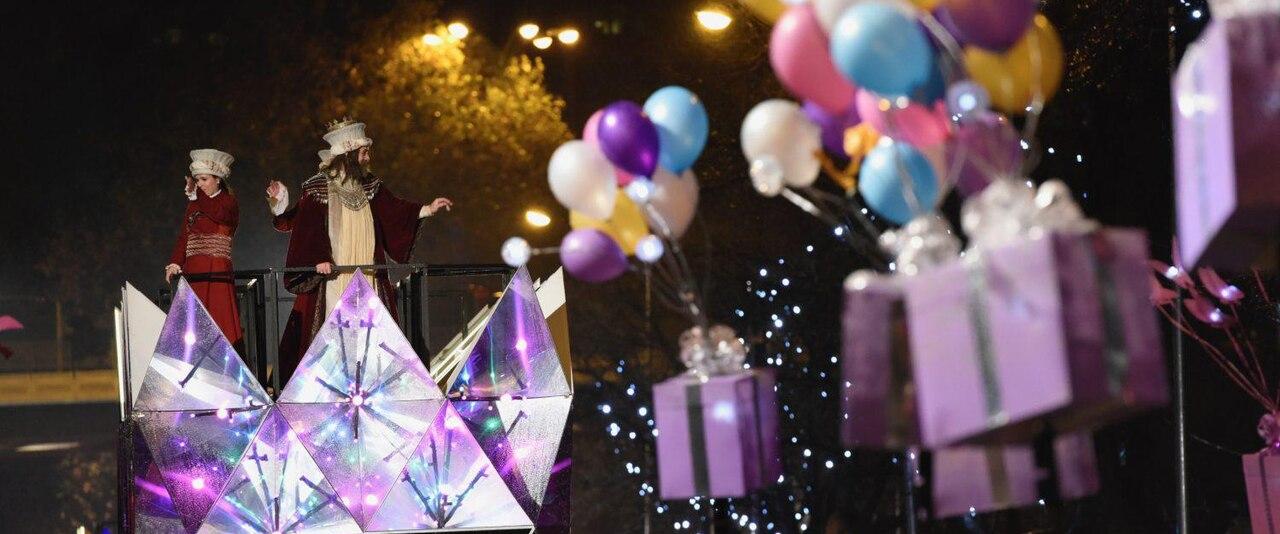
The format is much the same everywhere. The parade is led by heralds, bands and dancers, followed by floats, many of them sponsored, with costumed children and adults on board. The Kings come last, each on his own float or on horseback, surrounded by pages. Along the route, the people on the floats throw sweets into the crowd, and children bring bags, or open umbrellas upside down, to catch them.
In many cities the Kings first make a formal arrival, by boat or on camels. They receive the keys of the city from the mayor, and the parade ends at a nativity scene, a cathedral or the town hall with a message from the Kings.
When they get home, children leave their shoes by the door or the window, often with something for the Kings and water for their camels. In the morning of 6 January the presents are there, or a lump of sweet "coal" (carbón dulce) for children who have behaved badly.
Madrid: Castellana to Cibeles
Madrid's main parade crosses the city centre from north to south. In past years, according to Madrid City Council, it has started at 18:30 at Nuevos Ministerios (Plaza de San Juan de la Cruz). It runs down the Paseo de la Castellana, past Plaza del Doctor Marañón, Glorieta de Emilio Castelar and Plaza de Colón, then along the Paseo de Recoletos to Plaza de Cibeles. There the Kings give their message, followed by fireworks from the terraces of the Palacio de Cibeles at around 21:00.
The council has closed the Castellana and nearby streets to traffic for much of the day of 5 January and recommends the metro. Many of Madrid's districts also hold their own smaller parades. The 2027 route and times will be on madrid.es and esmadrid.com in late December.
For the markets, nativity scenes, lights and New Year's Eve in Puerta del Sol, see our guide to Madrid at Christmas.
Barcelona: the Kings arrive by sea
In Barcelona the Kings arrive by boat. On 5 January 2026, according to the city council, they landed from a schooner at the Portal de la Pau, by the Columbus monument, at 16:30, where the mayor gave them bread, salt and the magic key that opens every home. The Cavalcada de Reis left the Parc de la Ciutadella at 18:00 and passed the Columbus monument at about 18:35. It then ran along Avinguda del Paral·lel and Carrer de Sepúlveda towards Montjuïc, reaching its last timing point, on Avinguda Francesc Ferrer i Guàrdia, at 21:10. There was no capacity limit.
From mid-December until 6 January, the Fira de Reis fills the Gran Via with toy and sweet stalls, open until 03:00 on the night of 5 January. For the city's Christmas markets, see our guide to Barcelona's Christmas markets.
 A performer on a float in the Barcelona Three Kings parade. Image: Daniela Erminy, CC BY-SA 4.0, via Wikimedia Commons.
Seville: the Ateneo's parade since 1918
Seville's parade is run not by the council but by the Ateneo de Sevilla, a cultural society, which has organised it since 1918. It is one of the largest in Spain. According to the Ateneo, it has 33 floats, around 1,000 adults dressed as Bedouins walking alongside, about as many children riding on the floats, 30 pages on horseback and 10 bands.
The celebration starts the day before. On 4 January the Heraldo Real, the royal herald, rides through the old town to the City Hall to ask the mayor for the keys of the city, and collects children's letters on the way. In 2026 he set off at 17:00 from Calle Orfila.
On 5 January 2026 the parade left the University of Seville on Calle Palos de la Frontera, crossed into Triana by the Puente de Isabel II, and came back over the Puente de los Remedios. The route was adjusted that year because of roadworks, so check the 2027 route on the Ateneo's website, ateneodesevilla.es. The council set aside a quieter stretch, between the Glorieta de los Marineros Voluntarios and the Palacio de San Telmo, for people with autism and other special needs, and a reserved area for people with reduced mobility on Calle Palos de la Frontera.
The Ateneo has already named the three men who will play the Kings in 2027.
 A float in the Seville Three Kings parade, with sweets in mid-air. Image: Paul Asman and Jill Lenoble, CC BY 2.0, via Wikimedia Commons.
 King Balthazar's float passing the crowds in Seville. Image: Ateneo de Sevilla, CC BY-SA 3.0, via Wikimedia Commons.
Málaga: 13 floats and 20,000 kilos of sweets
Málaga's 2026 parade had 13 floats and about 1,000 participants, who threw some 20,000 kilos of sweets along the route, according to Málaga City Council. The Kings were received by the mayor at the door of the City Hall, and at the end of the parade they made their offering at a living nativity scene in the Cathedral. In 2026 the start was put back an hour, to 18:00, because of a rain forecast, which is a reminder to check the council's announcements on the day.
Málaga's districts also hold their own parades and children's parties in the days before, from 2 to 5 January. The programme is on malaga.eu. For the rest of the season, see our guide to Málaga at Christmas.
Alcoy: the oldest parade in Spain
If you want the most traditional parade in Spain, go to Alcoy (Alcoi), an inland town in the province of Alicante. Its tourism office says the Cavalcada has been held continuously since 1885, with written records going back to 1866, which makes it one of the oldest Three Kings parades in Spain. It is a Fiesta of National Tourist Interest and protected as intangible cultural heritage.
The day follows a fixed order. On the morning of 5 January, children visit the Kings' Royal Camp. At about 18:00, at nightfall, the Kings enter the town on camels, with musicians, torchbearers and shepherds. What makes Alcoy different is the pages, who climb long ladders to the balconies of houses along the route and hand over the presents in person. King Baltasar rides in the middle of the procession, not at the end. At about 20:00 the parade reaches the Plaça d'Espanya, where the Kings dismount and kneel at the nativity scene, while the crowd lights sparklers, fireworks go off and Handel's Messiah is performed.
If you cannot be there on 5 January, the tourism office suggests a visit to the town's Casal de Nadal, a space that recreates the Christmas celebrations, in a former chapel.
 A plaque in Alcoy honouring the group that pioneered the town's Three Kings parade, placed for its centenary in 1985. Image: Joanbanjo, CC BY-SA 4.0, via Wikimedia Commons.
Roscón de Reyes
The cake of the day is the roscón de Reyes, a ring of sweet, orange-blossom-scented bread decorated with candied fruit and flaked almonds. Many are sliced and filled with whipped cream, custard or truffle. Inside are two surprises: a small figure, which brings luck to whoever finds it, and a dried bean. By custom, whoever gets the bean pays for next year's roscón.
Most families eat it at breakfast or mid-afternoon on 6 January, often with hot chocolate. Bakeries take orders in the days before and sell out on the morning of the 6th, so order ahead if you want a good one.
 A roscón de Reyes, the ring-shaped cake eaten on 6 January. Image: Mpeinado, CC BY 3.0, via Wikimedia Commons.
6 January: what's open and what's closed?
6 January is a national public holiday in Spain. On Wednesday 6 January 2027, expect:
- Shops: most are closed, apart from some bakeries in the morning, convenience stores and shops in tourist areas.
- Banks, offices and post offices: closed.
- Museums and monuments: many open on holiday hours, often shorter than usual; some close. Check each one's website.
- Public transport: runs on a Sunday or holiday timetable.
- Restaurants: many open for family lunches, which are popular, so book.
The morning of 6 January is a family occasion, and the streets are quiet until midday. On 5 January many shops close early, and roads near the parade routes close from midday or early afternoon.
Tips for watching a Three Kings parade
- Arrive early. Crowds build an hour or more before the start, and the best spots near the beginning of the route fill first.
- Stand near the start if you want to see the parade at its freshest and avoid the long wait at the end.
- Bring a bag for sweets. Locals bring bags and upturned umbrellas. Keep small children back from the floats.
- Use public transport. Roads around the routes close, and parking is almost impossible.
- Check the weather and the council's channels on the day. Parades are sometimes delayed or shortened for rain, as in Málaga in 2026.
- Dress warmly. January evenings are cold, especially in Madrid and inland towns such as Alcoy.