Choosing When to Go
Season matters more for a family trip to Seville than almost anything else. July and August regularly bring afternoon temperatures near or above 40°C, which makes sightseeing with young children hard between late morning and early evening. Spring (March to May) and autumn (October and November) are far more comfortable.
Spring brings its own complication: Holy Week processions and the April Fair fill the centre with crowds, close streets and push up hotel prices. They are memorable for older children, but with toddlers it can be easier to come a week or two either side. Winter is mild and quiet, with short days and some rain.
Parks and Open Space
Seville has more green space than its dense old town suggests.
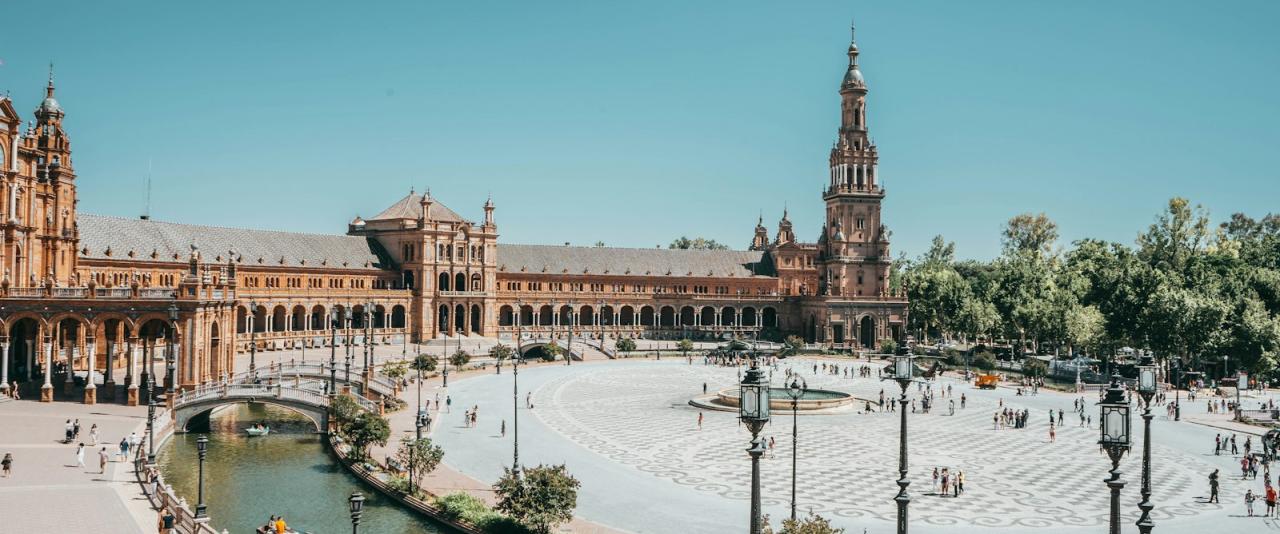
- Parque de María Luisa is the main city park, south of the centre, with shaded paths, fountains, ponds and room to run. At its edge, the Plaza de España, built for the 1929 Ibero-American Exposition, has a canal where rowing boats are usually available to hire, bridges to cross and tiled alcoves for each Spanish province that children enjoy hunting through.
- Plaza de América, at the other end of the park, is known for its many pigeons and open paving.
- Parque del Alamillo, north of the centre beside the Guadalquivir, is a large, flat park with play areas and space for bikes.
- Jardines de Murillo, along the wall of the Alcázar, are a shady stop when walking through Barrio Santa Cruz.
Sights That Work for Children
- Real Alcázar: the palace rooms are tiled and atmospheric, but the gardens are what younger children remember, with fountains, a hedge maze and peacocks. Book timed tickets online, especially in spring.
- Cathedral and Giralda: the bell tower is climbed by a series of ramps rather than steps, originally wide enough for a rider on horseback, which makes the ascent manageable for most school-age children. The views from the top are the reward.
- Torre del Oro: a riverside watchtower housing a small naval museum, quick to visit.
- Metropol Parasol (Las Setas): a walkway on top of the large timber canopy in Plaza de la Encarnación gives city views at sunset. There is an entrance charge for the roof.
- Casa de la Ciencia: a science museum in the Peru pavilion of the 1929 Exposition, near Parque de María Luisa, with exhibitions aimed at children.
- Acuario de Sevilla: an aquarium on the riverside at Muelle de las Delicias, organised around the route of the Magellan-Elcano voyage, which set out from Seville.
- Isla Mágica: a theme park on Isla de la Cartuja, the 1992 Expo site, with an adjoining water park. It opens seasonally rather than all year, with special events around Halloween, so check its calendar before planning a day around it.
Getting Around with a Stroller
The historic centre is compact but its lanes are narrow, often cobbled and shared with cars and bicycles. A light, folding stroller with good wheels copes better than a large travel system, and a baby carrier is useful for Santa Cruz. Pavements on the main avenues, the riverside and in the parks are smooth.
The Metrocentro tram runs a short line through the centre, buses cover the rest of the city and the single metro line links some outer districts. Taxis are plentiful and reasonably priced for short hops when small legs give out. Many attractions have stroller parking or ask you to leave strollers at the entrance.
Eating with Children
Spanish meal times are late: lunch is typically from about 14:00 and dinner from 21:00. Children are welcome in most bars and restaurants, including late in the evening, and it is normal to see families out after 22:00 in summer. Tapas suit children well because you can order small amounts of several dishes. Plain options such as tortilla de patatas, croquetas, grilled chicken, fried fish and salmorejo are widely available.
Snacks help bridge the gap between Spanish meal times and a child's routine. Supermarkets and bakeries are easy to find in every neighbourhood.
Heat and Daily Rhythm
Plan the day around the sun. Visit outdoor sights early in the morning, return to your accommodation or an air-conditioned museum in the hottest hours, and go out again in the evening when Sevillians do. In summer, a hotel or flat with air conditioning and, ideally, a pool makes a large difference.
Carry water and sun protection at all times, choose shaded routes through parks and side streets, and remember that the reflection off pale paving and walls adds to the heat.
Where to Stay
Families usually choose between the old centre, for walking access to the main sights, and quieter areas such as Triana or the streets near Parque de María Luisa. Apartments with a kitchen and a washing machine are practical for longer stays; check that a holiday rental displays its regional tourist licence number and confirm air conditioning in every bedroom before booking.